In partnership with

Today’s advertiser is Lending tree. Although Beehiiv rules forbid me from asking or encouraging you to click the ad, if you do so, of your own free will and according to your own moral principles, each click will earn me $1.50.

Matt Damon as Odysseus and Zendaya as Athena.
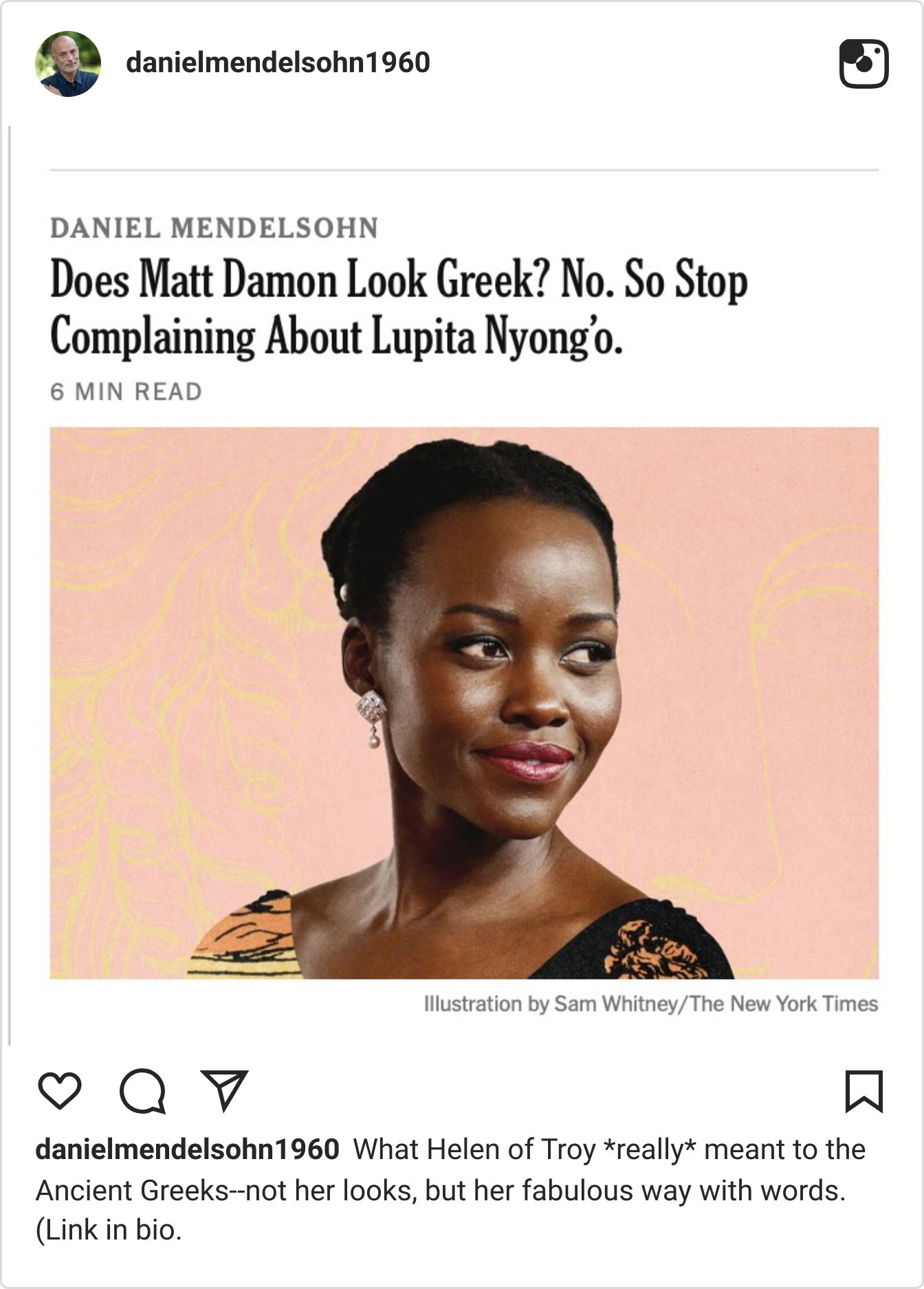
Welcome back to Odyssey Week! Yesterday we delved into the strangeness of The Odyssey, and the challenges of turning it into a Hollywood blockbuster. Today we’re talking to Daniel Mendelsohn: He’s a professor of literature at Bard, but more important1, he’s a classicist, a translator of The Odyssey (2025) and the author of (among many other books) An Odyssey (2017), a memoir about his contentious relationship with his aging father, who decides one semester to audit his son’s course on The Odyssey. It’s no exaggeration to say I loved the book, both for the way it opened up facets of the story I wasn’t aware of and for the moving and ultimately powerful portrait of the father-son relationship. It’s why I recently got in touch with him to talk about how he would like to see The Odyssey turned into a movie.
Our conversation is below, condensed and lightly edited for clarity.
MG: I imagine once or twice you might have imagined what The Odyssey would be like as a movie.
DM: This is a favorite parlor game, of course, of classicists — you know, casting the classics. I hate to admit this, but I remember when I was an undergraduate at Virginia and people were playing that game, the two names that came up for Odysseus and Penelope were Richard Burton and Elizabeth Taylor. So that's how far I go back.
Did you talk about how to actually structure this incredibly long and unwieldy story into what would then have been a 90-minute Hollywood production?
When people think about The Odyssey they think about the adventures, right? The Cyclops, Scylla and Charybdis, the Lotus Eaters, blah, blah, blah, blah, blah. But, you know, you have to remember that that takes up 4 books out of 24.
It actually only represents one-sixth of the poem, although it tends to dominate the imagination. But the real story is how to get this guy home, and also how to reintegrate him into the life that he had which has become very strange to him. Opinions are split because, of course, the adventures are more cinematic. But the drama, I would venture to say, is really the other thing that captures our imagination, which is the homecoming story.
And that has been remade, right? The Return of Martin Guerre, and I guess it was the '70s, the French film. You know, that movie with Jodie Foster, Sommersby, I think it was called. About a Civil War veteran coming home. I think it was Richard Gere actually, and it's not clear whether it's the same guy who left. And at a certain point, does it really matter 'cause maybe he's better than the guy who went away.
You have these two conflicting potential narrative trajectories. One is a homecoming story, which is fraught but ultimately heartwarming, and the other is an adventure story.
The Odyssey is an epic, so it's able to encompass both. But if you're making a movie you have to think of a way to entwine them. I'm quite intrigued by the Christopher Nolan thing because it is something he's very good at, which is convoluted time-bending narratives, which is exactly what The Odyssey is. I know a lot of classicists who are pooh-poohing the idea of Nolan, but I'm like, "If there is a guy who can do this right, it's actually him." I don't get wrapped up in the Reddits about whether the ships are accurate or the armor is accurate. I'm like, "Accurate to what?" It's a fantasy story.
Written by a person or people who were writing about events that occurred hundreds of years earlier anyway.
Yeah, exactly. So that stuff doesn't bother me. I always think it's more if you get the spirit of the thing right.
One of the very first things I ever wrote about, and this goes back to the early '90s, was there was a miniseries of The Odyssey with Armand Assante as Odysseus and Isabella Rossellini as Athena.
I like that.
It wasn't very good, but it's like Laura Miller was my editor at Salon — that's how far back this goes. You know, there's that movie called The Return, with Ralph Fiennes and Juliette Binoche. It cuts off the whole first half of The Odyssey. So it starts when he gets back. It was not successful, but it was not stupid by a long shot. It was quite intelligently done, with very good performances. It's irresistible, I think, for people to want to dramatize this, but there are many pitfalls.
One of the strange things is how few attempts have even been made. You know, lots and lots of Greek mythology in movies, but not a lot of Odyssey.
Well, because the problem, in quotes, is there's so much of it. There's not a single adventure, you know. There are many adventures, all of which mean something, you know? And then so you're balancing a kind of multifaceted plot, and it's hard to condense. That's why I thought the miniseries might be the best way to go about it. 'Cause you can handle these various timelines.
So on the one hand, there's his homecoming story. The other thread is the maturation of Telemachus, the son, which is a whole arc, very important arc. There's Penelope fending off the suitors. That's a whole other drama. It's a many-headed Hydra, and I think very hard to boil down in the way you need to boil down for even a two-and-a-half-hour movie.
More after the ad…
🪨
Overpaying for car insurance? Find out.

Find out if you have the best deal. Compare multiple car insurance quotes in one place and compare them to your current monthly rate. Just answer a few questions on LendingTree and get your quotes instantly.
🪨
So what episodes, what elements can you safely lose from The Odyssey if you were making, say, a three-hour movie of it? What is less important?
There are a number of the adventures that are thematically important, and I certainly wouldn't want to jettison them when I'm teaching it. But you don't need the Laestrygonians. The Cicones, which is the first thing that happens to him. Honestly, I think you could even lose the Lotus Eaters.
Yeah, that's like a blip.
It is a blip. It is a blip. It's the first stoners in Western literature. If you had to do one thing, I think it would be the Cyclops. Because it is the most emblematic of how he operates.
You've gotta have Circe. I always like to quote an unnamed female classicist friend of mine who says, "Turning men into pigs is redundant."
The hardest thing, I think, to do is the cattle of the sun. Which you have to include because it the reason why none of his men make it home. It is the sin for which they all get shipwrecked and drowned, but it's hard to explain. It's hard to dramatize. It's such an obscure theological point. You cannot eat these cows that belong to the sun god, you know? It's a little wonky, but it's so important. In fact, it's the only adventure mentioned in the opening line. So Homer thought it was important, but it will always strike us as a little weird.
The theology is an interesting point. I’ve been trying to imagine, like, how do you make a movie of The Odyssey that feels right to audiences in 2026? And I think the gods are a little problematic. This is a deus ex machina constantly, and I wonder is there a way to make this movie without showing the gods at all?
I’ll evade your question in an interesting way. I will say that it is easier to make an Odyssey without the gods than an Iliad without the gods. The gods are all over the action of The Iliad. They're making things happen. They're fighting on the battlefield. They're whispering advice.
You know, the gods are already a little absent in The Odyssey. I mean, except for Athena, who's transforming him every now and then and gives him a little boost during the climactic battle scene. I think you actually could do it. You remember all those shows from the '80s like Moonlighting and Remington Steele, where there was a male/female couple that you knew were never gonna get together? I think that's really what's going on between Athena and Odysseus. There's a kind of flirtatious energy between them that, of course, can't be consummated, but I would want that to be part of any Odyssey movie because she does move things along. And the whole reason this narrative happens is because the whole thing starts with her saying to her father, "Come on, Dad, let's get this guy home already."
He's her favorite.
I don't think you need anyone else particularly, but I do think you need to work her in. But there would be all kinds of clever ways to suggest a supernatural presence without actually having some lady wearing armor, you know?
The problem whenever Hollywood addresses the classics is it gets very portentous. I always joke that the script of the Ten Commandments was probably written on granite tablets. It's so heavy, and nobody talks that way. Whereas people in The Odyssey, although the register is elevated, they talk quite naturally to each other.
I was watching one furious Twitter thread just yesterday about people complaining that they had American accents. I was like, "Why does everyone think the Greeks and Romans spoke with British accents?"
The latest one I saw was everybody complaining that Tom Holland has a line where he says, "My dad is coming home," and they're just like, "Dad? Dad. Dad, come on."
I waded into this on Twitter, but what is actually interesting is that there is a word for daddy or papa. Which is atta, and Telemachus does use it — but he doesn't use it of his father. He uses it of Eumaeus, the nice swineherd, who basically is the guy who raises him, and he calls him Pops. But Odysseus he only ever calls pater, father, because he doesn't know him.
It's just such a great detail on Homer's part, right? He doesn't use the nickname, 'cause he doesn't know the guy. He's never met him. But with the swineherd, it's all father-son affection, blah, blah, blah, and he does use that word. So there's nothing wrong with “daddy,” because it is in The Odyssey.
Where would you start the movie, and where would you end the movie?
That's a very hard question. I think Homer knows what he's doing. You need to start it in the present at the moment right before he gets back home. I'm thinking not as a classicist now, but as a screenwriter. You have to establish the stakes. Why is it so important that this guy get home? Not from his point of view, right? He wants to get home. But from home's point of view — the kingdom is falling apart, the wife is at her wit's end, she can't keep these guys at bay anymore, the kid is a mess, he needs a father figure, he doesn't know how to do anything. So I think the smart way to start is the way Homer starts, by showing what the crisis is, and then you can do your flashbacks. And there are a number of flashbacks in The Odyssey, not just the long one where he tells everything that happened to him, but to the moment he left for the Trojan War.
And then the ending of The Odyssey is famously problematic. A lot of people don't like it. A lot of scholars think it was cobbled together at the last minute. It ends quite abruptly. I don't know. I think if I were ending The Odyssey, I would end with an element that's in the text, but it doesn't come last, which is that when Odysseus is in the underworld, he's told that as soon as he gets back home, he's gonna have to hit the road again. Because he has to make this expiatory ritual gesture to Poseidon, whom he has pissed off, and go inland and plant the oar. That's how I would end, and maybe just show this guy leaving again, because the fact is he's never not moving, right? Just a shot of him starting this new trek, walking into the distance, would be very eloquent.
His journeys are not ever gonna be over. And in fact, so you know, the prophecy says you have to go so far inland that they don't know what salt is, because salt comes from the sea. But as my professor once pointed out to me, there is no place on earth that doesn't have salt in one kind or another. So it really means that he's going on a journey that never ends. I think Homer knew that. So the guy never really gets to go home. I think that would be a great way to end.
Are there red flags in Odyssey movies that make you start to dismiss the project?
For me, the worst thing you could do is tell the story in chronological order. 'Cause, you know, the other favorite parlor game of Odyssey scholars is trying to unkink the narrative. It happens way out of order, and I think that's part of its interest. And as I recall, the miniseries from the early '90s with Armand Assante makes it actually very boring. So that movie started with the birth of Telemachus, as I recall. And then the Trojan War comes, and he has to go away, and then he fights at Troy, and then he tries to get home and blah, blah, blah. So when you do it linearly, it loses all of its coiled suspense.
One of the things I'm curious to see how they handle is when Odysseus kills the slave girls after killing the suitors. That is not your usual Hollywood hero thing to do. Are they gonna include that, or are they gonna get them out, or are they gonna make the slave girls look more evil than—
Well, they are evil. I'm not in Emily Wilson's camp on this question. Homer makes it very clear. He paints a very vivid portrait of the leader of the disloyal maids, Melantho; she commits the same religious sin that the suitors did, which is she violates the laws of hospitality. When Odysseus is in the house disguised as a beggar, she abuses him, she rails at him. These girls, by the Greek standards, deserve to die. I think Wilson is totally wrong on this point. It is also worth pointing out that Odysseus does not kill them. Telemachus kills them.
Okay. That's fair.
And it is also worth pointing out that Odysseus tells him to execute them, to run them through with the sword. It's Telemachus' idea to make them suffer by hanging them rather than dispatching them with the sword, and that is a brilliant piece of characterization, 'cause this kid has had to live with these women humiliating his mother day after day. At the end of The Odyssey, the two most cruel revenges are the hanging of these disloyal maids, and also the way that the awful goatherd, Melanthius, is tortured by Eumaeus and Philoetius, the loyal swineherd. Because again, they've been living with this abuse for years. They've been watching their masters be betrayed, and so I think it makes a certain kind of psychological sense.
As I think Bernard Knox says, the closest thing in the world of Homer there is to a universal law is the law of hospitality. And it is hard for us to think of it this way, but the suitors' violation of that and the disloyal maids' violation of that, in the eyes of the Greek, merits death.
So that's what I'm really curious about. I get that they were operating on different moral theological principles. But how do you make that work in a big Hollywood movie? How do we expect people to know they violated the laws of hospitality? How do we set that up so that pretty violent revenge murders at the end feel not like overkill?
I think you're right. I mean, but that you would have to dramatize. First of all, the hospitality thing is all over The Odyssey, so that's not a problem. I mean, it's so important. It is the reason all the suitors have to die. Remember, in Greek religion, Zeus presides over hospitality. If you break the laws, you're answerable to Zeus, so it's a big deal. You would have to think of a way to write this in at various points. You know, when he's given hospitality by the Phaeacians.
There would be ways to underscore that this is a big deal. The reason that the famous ruse of the weaving that Penelope uses to put off the suitors — the reason it didn't work is one of the maids ratted her out. The Odyssey tells us that Odysseus' mother raised the slaves along with her own children as one of her own children, and that Penelope had raised this maid, Melantho, as if she were her own daughter. There are ways to point up the sense of betrayal that the family feels when these slaves betrayed them that would establish a certain kind of emotional stake.
But yeah, look, there are aspects of this culture that are very hard for us to swallow. So the question is, do you present it as a document about a civilization that is very foreign to us, or do you try to make it seem universal? In which case, the kind of thing you're talking about becomes a real problem.
Are you gonna go see this movie on opening night or opening weekend?
You know, I think I'm gonna go see a press preview because I'm writing about it. So I will luckily avoid that, but I do wanna see it in IMAX. I will sneak in at a 10 a.m. matinee during a weekday maybe. 🪨🪨🪨
Read a Previous Attempt: The Odyssey is strange

1 Mendelsohn and I also briefly overlapped at New York Magazine a million years ago.