
In partnership with

Today’s advertiser is Kajabi. Although Beehiiv rules forbid me from asking or encouraging you to click the ad, if you do so, of your own free will and according to your own moral principles, each click will earn me $1.68.

“Heathers” (1989).
Any story about Generation X is required to begin with its author’s attempt to establish their own Gen X bona fides. But screw that! I was born in 1974, so I don’t have to play by those corporate-journalism rules. I’m no sellout1! The only reason I’m not publishing this essay as a poorly reproduced ‘zine is that there are no more corner copy shops left in which to Xerox it. So you’ll just have to trust me when I say I know what I’m talking about, X-wise. If that’s not enough, I could go fetch the photos from my last colonoscopy — no generational fides more bona than that.
I’m taking on this important topic because T Magazine has a big package out about Generation X. Is Gen X Actually the Greatest Generation? asks the main bar, by Amanda Fortini, while T EIC Hanya Yanagihara asks What Is Gen X’s Legacy? One of the Polish Jameses has a nice piece about how cartoons grew up under Gen X (whoops, wrong link! (whoops again!)), and there’s a video interview with many famous people who are around my age. It’s all well-written, well-argued, and beautifully produced, ultimately making the case that my generation has had an outsize impact on American culture.
But I could have written this reaction piece at almost any point in the last ten years. Generation X is a perennial subject, whether framed as a forgotten generation, credited/blamed for everything that’s great/awful, tarred as the Trumpiest generation and also not the Trumpiest generation, hated, horny, obsolete, unprepared for retirement, and about to become filthy rich. Also, there are memes!
You could take all of this as evidence of Gen X’s ongoing relevance, but it’s really just smart editorial programming: Americans love to argue about generational differences, from the precise years that “define” generations to the evolution of slang, from changing work habits to whose music/movies/books/fashion was best. Get a writer or group of writers to declare something wild about a generation — hm, how about “Everyone is wrong about Generation X”? — and you create an instant audience of readers who will want to argue with them. It doesn’t really matter if they’re right or wrong, if the story is based on real reporting or just vibes. People lap that shit up. And the point is always to get them lapping and keep them lapping.
Because I’m a Gen Xer, and therefore care only about Gen X, my point is that they’re all wrong. And it’s a point I’ll try to make with both data and vibes.
More after the ad…
🪨
How to Take Your Fitness Business Online.

Your time is limited, but your impact doesn’t have to be. Kajabi’s new guide, 30 Days to Launch: Scale Your Fitness Business Online, will show you how to grow your income and reach more clients by combining in-person and online programs.
Learn the hybrid model, follow a step-by-step launch plan, and use Kajabi’s all-in-one platform complete with courses, communities, and coaching to manage and scale your business.
🪨
To define Generation X, you first have to define the Baby Boomers. This is easy — it’s right in the name! From 1946 to 1964, the United States experienced a postwar population surge, a so-called “boom” of [checks notes] “babies.”
“The National Center for Health Statistics (NCHS) recorded 2.9 million births in 1945, which increased by almost 20 percent to 3.4 million births in 1946 (NCHS 2005). Births continued to increase through the rest of the 1940s and into the 1950s, reaching a peak of 4.3 million in 1957,” according to Census.gov. Altogether, we’re talking about 80 million boomers.
By 1965, the Census article goes on, “the baby boom had ended, and births fell below the 4 million mark—a level not exceeded again until 1989, when baby boomers were having children of their own.”
So there’s the hard demographic definition for you: Generation X is the generation of less. From 1965 till 1980 or 1981 or 1984 — however you want to define the end — there just weren’t as many of us as the boomers. As much as our childhoods were shaped by the rise of Ronald Reagan and the brutal ménage à trois of drugs, AIDS, and nuclear war, they were more broadly defined by simply coming after two or three decades of boomer-led cultural upheaval. Their optimistic 1960s were over. Their music and movies and books and art still dominated. Their votes still counted more. There were 12 million more of them than us, so we lived in their perpetual cultural, economic, and political shadow.
And we still do! I’ve been digging into data collected by the Annie E. Casey Foundation, which shows that in 2010 (the earliest year for which they have data), Generation X made up a smaller share of the U.S. population than either the boomers or Millennials — and that even in 2024 there remained slightly more boomers than Xers3. (Millennials and Gen Z outrank us both, with Gen Alpha now climbing.) Maybe when the 2025 figures come out — there’ll be a big release party, right? — we’ll discover that there are finally more of us than them. Better, uh, late than never?
To me, this is not just a demographic story but the key principle of Generation X culture. We grew up being told the greatest accomplishments had already been achieved. We missed the party, and the space race, and the war, and the protests, and the sex, all of which continued to surround us in the mainstream, boomer-driven, prematurely nostalgic pop culture of the 1980s. (Note to my parents, who were born in 1942 and 1945 and so aren’t technically boomers: This isn’t anyone’s fault! It’s an observation, not a criticism!) Is it any wonder that, faced with an era of degrowth and disappointment, we chose to opt out, to make silly zines and loud music and weird, often unwatchable movies? Even 50 years later, we remain a generation of lowered expectations, especially in contrast to the careerist Millennials who erupted into the public consciousness in overwhelming numbers just as we Gen Xers were coming into our own as adults. We missed that party, too.
As with so many other Gen X articles, I’ll reframe our tragic upbringing as a strength: Because we had as children such low expectations, we have not been disappointed by life. It has sucked more or less how we thought it would! We knew we would never be No. 1, and now that we’re No. 3 or maybe No. 4, we’re fine with it. We found ways to enjoy ourselves among the wreckage, and not all of us sold out our ideals. Thanks to our small population, we may never have held the power of previous generations, but hey, that means we bear less of the blame for the sorry state of the world. Bonus!
For the writers at T, this seems to be proof of our outsize influence. But that seems a little off to me. Because after all that my generation has been through, who needs to spend thousands of words arguing for our importance? After a lifetime of being dismissed and overlooked, what could we gain from this belated attention? Our time in the spotlight, as brief and minor as it was, has long since passed, and no onslaught of feature stories will bring it back or make it more meaningful than it was then. Besides, nostalgia is for boomers. For us? Better never than whatever.
It’s worth putting things in perspective, too. This concept of generations is still new. Before the baby boomers, we have, what, the Silent Generation? The Lost Generation? And before that? Who knows? Together, the Silents and the Lost cover 50 years of American life, a half-century of incredibly varied experience and output that you’d be hard-pressed to slot into the kind of pigeonholes with which we stereotype boomer, Gen X, and Millennial cultures — but that continues to echo and influence as much as anything that followed. We still listen to big-band jazz and watch silent movies and grapple with the protectionist regime of the Smoot-Hawley Act, and we will for generations to come, just as we’ll rock out to the Rolling Stones and Smashing Pumpkins, obsess over Martin Scorsese and Todd Haynes, and either fight the power or become the Establishment.
To put the works of this paltry handful of generations up against one another is premature. We live in an era in which nothing is ever lost, and nothing ever dies — it will be generations more before we can see what really stood out, and whether any cohort won these unending culture wars. Will The Simpsons remain relevant a century from now, or will it become Rocky & Bullwinkle, name-checked but unwatched, a footnote? Generation Alpha is still being born; better to wait till we hit Omega (Gen OMG?) before making any pronouncements.
That is, of course, if humanity makes it that far. As I’m a card-carrying member of Generation X — that card, if you’re wondering, is AARP — my expectations are about as low as you’d expect2. And if The End™ does come sooner rather than later, if I’m around to witness it, you can be damn sure that whether it arrives by nuke or by virus, by polluted skies or acidified seas, by zombies or by aliens, I will be right there facing it, and telling anyone left who will listen that my generation did the apocalypse so much better and certainly cooler than this played-out, recycled genocide. And if I am the last man on Earth — if there’s truly no one left to upgrade to a paid subscription listen to my rants? Oh well, whatever, never mind. 🪨🪨🪨
It’s Good and I Like It: Verity & Daughters
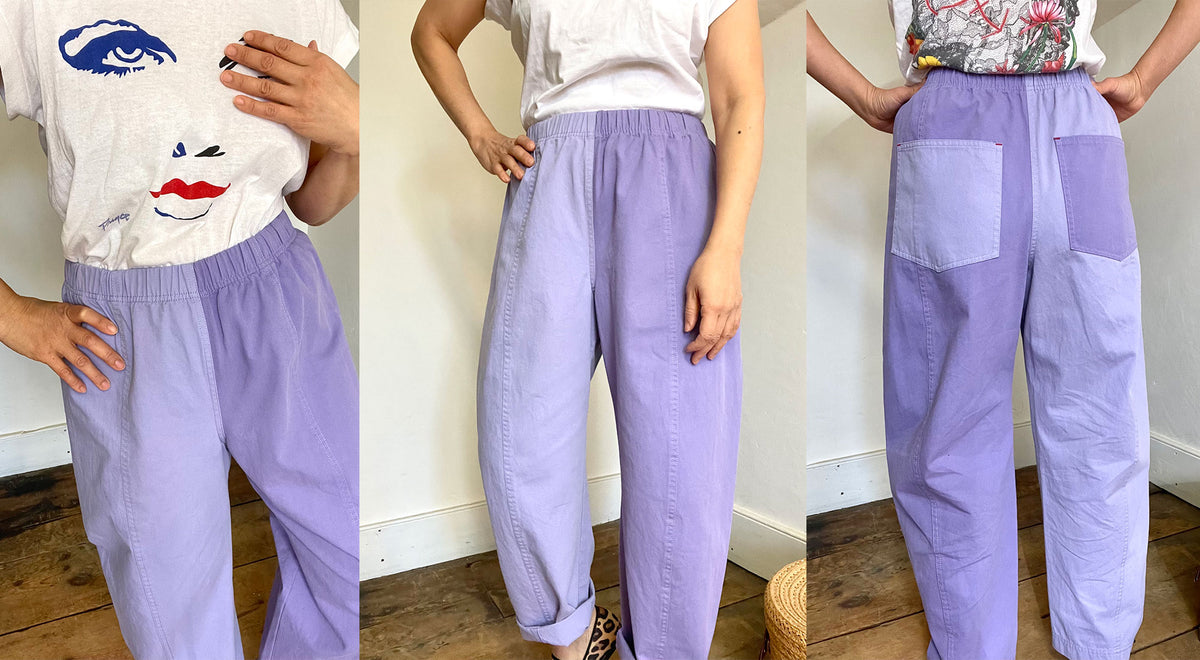
Seven years ago, my wife, Jean, founded the women’s fashion label Verity & Daughters, and it’s still going strong! Pants are their big thing — cozy, cool, and colorful — but everything she designs is awesome. Since it’s the holiday season, she’s ginned up a 15% discount code, TRYING15, for all Trying! readers (hint hint, her clothes make great gifts!):
1 No one wants to buy what I’m selling anyway.
2 Hello, hello, hello, how low?
3 Here’s my Google Sheets rendition of that data.