Sponsored by

Today’s advertiser is the National Audubon Society. Although Beehiiv rules forbid me from asking or encouraging you to click the ad, if you do so, of your own free will and according to your own moral principles, each click will earn me $1.68.

Nearing the Issue at the Cockpit (1879), Horace Bonham
Until a few years ago, there was a bar in my Brooklyn neighborhood called Lavender Lake. It was named, of course, for the adjacent Gowanus Canal, famous as one of the most polluted waterways in the United States, where we treat polluting our waterways as a competitive sport, like baseball and tax evasion. For well over a century, nearby oil depots dumped their waste into the canal, hard rains pushed sewage overflow into it, and generous citizens did their part by tossing in handguns, bodies, and automobiles. Over time, the Gowanus developed an unmistakable aroma, not to mention a variety of hues that earned it that nickname: Lavender Lake.
The bar was about what you’d expect a canal-side bar with a name like Lavender Lake to be. Affordable, dark, crowded, with a back deck that looked out on the canal, suffused with various odors. But what made Lavender Lake special— No, that’s not even the right way to put it. This wasn’t the bar’s selling point, it didn’t even seem to be something the bar was fully aware of. What made Lavender Lake memorable, at least to me, was its food. It was pretty good! The smashburger was thin-pattied and cheese-topped, with remarkably fresh lettuce and tomato; you could get a side of radishes with good butter and flaky salt; they knew how to fry Brussels sprouts. (Here’s their current menu, in their new, non-Gowanus-adjacent location.) None of these dishes were amazing. You would never go to Lavender Lake just to eat, but if you were there for a drink and happened to order some chicken wings or even a salad, you’d be pleasantly surprised. You’d think to yourself, This is better than it needs to be!
Better than it needs to be — that’s high praise in my life and my home these days. Take Fillo’s Walking Tamales, which I stumbled onto in my hotel lobby during a recent long-weekend stay in the Berkshires. They’re, well, tamales, so mostly masa, with some beans and other flavorings, all sealed in a shelf-stable pack. They look like the kind of $2 snack that people who want to be healthy and cosmopolitan — or, really, to be seen as healthy and cosmopolitan — would stash in their purses, consume on easy day hikes, or munch during a commute instead of a high-protein Clif bar. Except that they’re delicious: nicely corny, the beans whole and just soft enough, the spice levels true to the packaging. Take a look at the ingredients and it gets better. No preservatives, no chemicals, no disassembled-reassembled flours. Technically, this is processed food, but it sure doesn’t feel like it. And frankly, Fillo’s could’ve gotten away with much, much less! Cheaper masa, disintegrating beans, chili extracts — most people would not have noticed or, if they did, cared. Instead, Fillo’s Walking Tamales wound up being not just good but better than they needed to be!
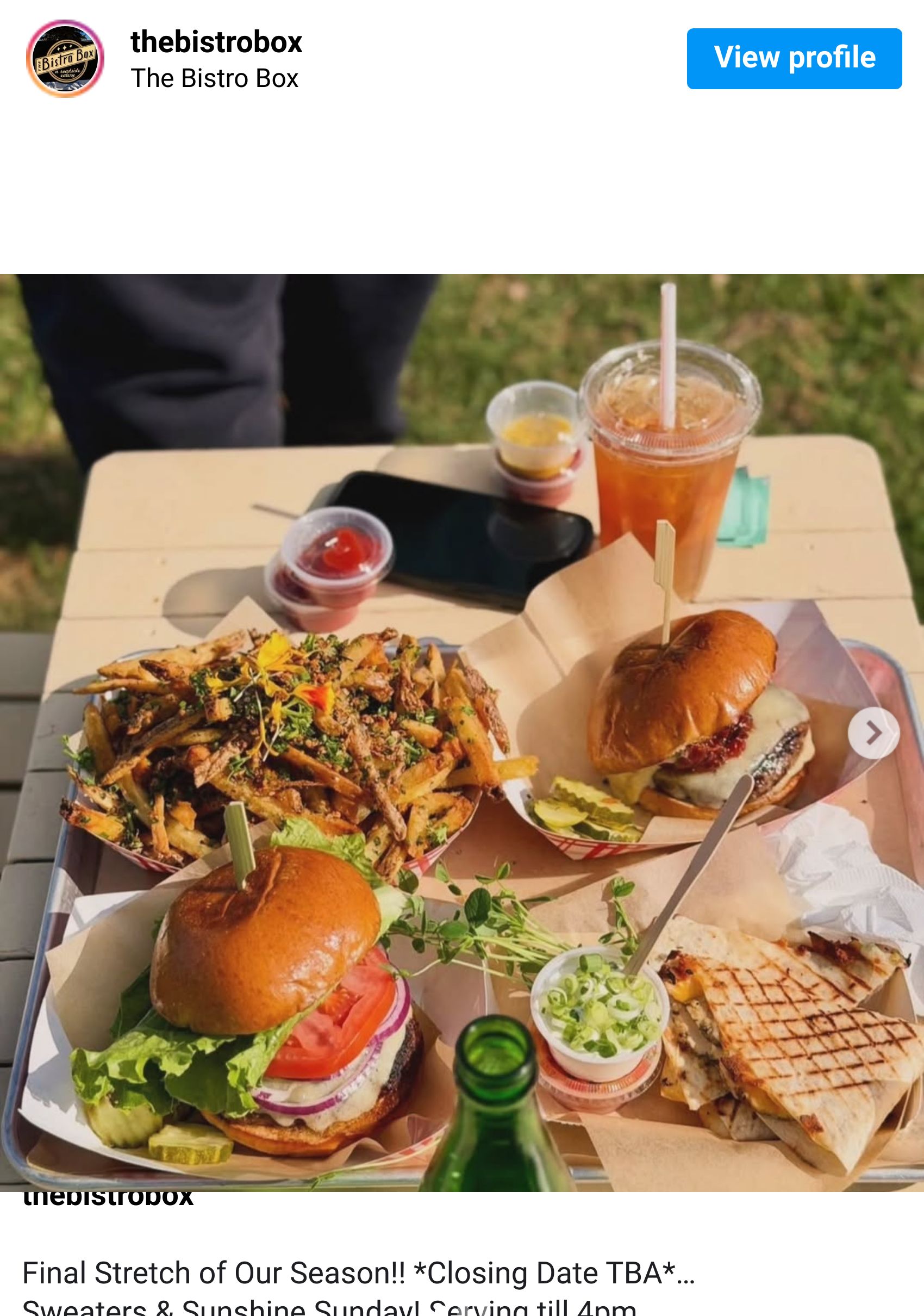
Likewise the garlic-herb French fries at the Bistro Box, a roadside burger shack that’s also in the Berkshires — the kind of place you might stop into for a thoughtless, easy, cheap lunch on the way from one place to another. Yet these fries were excellent, hot and crispy, skin-on and barnacled with golden-brown fried garlic and minced fresh herbs. (The burgers weren’t bad, neither!) The Bistro Box could have gotten away with so much less. But they didn’t. They are better than they need to be.
More after the ad…
🪨
Support Audubon & Receive a Gift

American Goldfinch. Photo: Megumi Aita/Audubon Photography Awards
Become a member of the National Audubon Society today, and we’ll send you our exclusive, award-winning magazine as a token of our appreciation. That means every three months you’ll receive stories about protecting birds and the places they need directly to your mailbox!
With over 120 years of conservation expertise, Audubon is responding to the greatest challenges facing birds and people today while anticipating the issues and opportunities of tomorrow. Where we work - and when you help - birds are better off.
Give a gift that renews each year to ensure our quarterly magazine continues arriving at your doorstep.
🪨
“Better than it needs to be” isn’t quite as simple as that, though. The concept has specific rules that give it unusual heft. For one, the producer of something that is better than it needs to be can’t be seen as trying too hard to excel, because then their visible ambitions raise our expectations. Rather, the quality of their product should feel almost incidental — an outgrowth of the maker’s perhaps thoughtless mastery of the craft. My favorite pair of pants, for example, close with a button at the top, and for the eight years I’ve had them, through countless wears, the threads connecting that button have never come undone. They haven’t even frayed. This is shocking to me: Every other button I’ve ever had on every other garment for decades has come off, sometimes after mere weeks of wear. But not this button. Whoever designed these pants knew enough about stitching and usage to attach that button with care and precision, even though that tiny detail would likely go overlooked by anyone trying on the garment. They weren’t trying to wow anyone with this subtle bit of construction; no salesman would have called attention to it. And if the button had come off, I wouldn’t have been disappointed — that’s what buttons do, in my experience. The pants would have been just like every other pair of pants in that respect, though still my favorites. The button was only a minor part of my love.
Or perhaps I’m assuming too much here? It’s entirely possible that “better than it needs to be” could be the work of secretly ambitious craftsmen trying to sneak above-average quality into a ho-hum world, like the original auteurs of the 1930s Hollywood studio system. The Bistro Box surely must know by now how good it is — in 2026, those fries can’t be an accident. (I mean, this place does fries with wild ramp pesto and goat cheese, so someone there knows what’s up.) Still, they feel accidental. And better than that, on a random Saturday when you’re just looking for a lunch to keep you going, they feel like a revelation.
So much of this can be chalked up to our own expectations. Which are often as low as they are high. We live in a world obsessed with the best: the best restaurants, the best college majors, the best running shoes for wide feet, the best cervical foam rollers, the best chapstick, the best towel warmer. We have infinite Internet links to follow that promise to direct us to outlets so good that everything afterwards will pale in comparison. And we are expected — we expect ourselves — to seek out the best. Who wouldn’t want the best, after all? What kind of sucker would settle for less than the best?
But quite frequently we are unable to select and enjoy “the best.” Whether because of geography, price, or timing, the best remains out of reach and we instead have to settle for things farther down the list — inferior cafes, substandard towel warmers, C+ careers. In fact, I bet that’s where most of us spend the most time, living arm’s-length from the Top 50, accepting USB desk lamps and carnitas burritos that keep our workspaces illuminated and our bellies full, but without joy or wonder (or status). Because our expectations can be so high, they wind up quite low — or, worse, middling. Compared with the best, everything else melds into an undifferentiated miasma of baseline quality. We accept what we can accept.
Me, I try not to get too obsessed with the best. I’ve tried to cultivate an appreciation for the B+/A- things in life. Still, I’ve had enough disappointments, and enough moments where I needed simple satisfaction rather than mind-blowing quality — a boring old tuna melt, the cheapest cervical foam roller — that my own expectations have shrunk. I’ve found I can live without the best, and so I do.
Which is why those “better than it needs to be” moments hit me so hard. They’re reminders that even in our degraded world, quality survives. Mastery survives. People who care about what they’re doing survive, and those people believe, or imagine, that people like us survive as well — people who recognize and appreciate the extra effort they’ve gone through to make the world every so slightly better, without expecting riches or glory or even recognition. They are artists, and they are professionals, and we need to thank them, whether silently or aloud, because every time we say to ourselves, “This is better than it needs to be,” we remind ourselves that our reality itself needs to be better, and can be better, and that the ones who will make it that way are us. Is us? Is we? Whatever: We is — and we will! 🪨🪨🪨
Poll: Was this email better than it needed to be?
Hey there, {{first_name|reader}}! Assuage your guilt by upgrading to a paid subscription.
It’s Good and I Like It: Rooster
You probably didn’t watch Rooster, the new show starring Steve Carell that just finished its first season on HBO Max. And that’s okay, because it’s a wholly unnecessary show: Who needs to see Carell as Greg Russo, a divorced writer of best-selling thriller novels who is persuaded to teach for a semester at Ludlow College, a Northeast liberal-arts school that feels like the setting for a comedic postwar campus novel? Me, I guess! The supporting cast is wonderful — especially John C. McGinley as the college president who spends hours in his home sauna fretting that he’s going to be replaced by Russo’s ex-wife (Connie Britton) — and each episode hums along in less than 30 minutes, chock-full of brilliant throwaway lines. Is it a successful satire of contemporary higher education? Definitely not! But it is entertaining and won’t make you feel like a dumb-dumb.
