
Des Mots! Des Mots! (1896), Abel-Truchet
When I think about living forever — which is often, because I think about dying all the time — I wonder what language I’ll be speaking a few millennia from now. The English we use is only about 500 years old, and I’m skeptical I could communicate easily with an Elizabethan, so just imagine how much that language, so forgiving, so flexible, so assimilationist, could change in ten times that stretch. Chances are, it would be unrecognizable.
And it could even go away entirely. As we all know, oceans rise and empires fall, and with them new tongues come to prominence. Maybe the language of the future will more closely resemble Brazilian Portuguese or Bahasa Indonesia, or some amalgam whose ethnic or national identity has yet to be invented. Whatever the common tongue winds up being, I’m sure I will, in the fullness of my eternal lifespan, learn to wield it like a native. If all goes well, I won’t even realize my entire means of communication has shifted.
What I’m less certain about is how much English I would retain. It seems unbelievable that I could lose it: English isn’t just my mother tongue, it’s a language I’ve embraced wholeheartedly — I’m a goddamn writer after all, and one, I hope, who takes joyful advantage of its endless quirks and cadences. Writing these little sentences and paragraphs for you a few days a week makes me enormously happy. How in the course of a few thousand years could I let that slip away?
No, really, how? Because English isn’t my only language: The French I learned in high school is still reasonably good, as is the Italian I took a semester of in college. My Vietnamese and my Chinese are not reasonably good, but their level of badness hasn’t changed much since the late 1990s. Thanks to a three-week class I took in 1995, I can still read (or at least sound out) Korean’s hangul alphabet, even though I can’t count higher than five. In other words, words stick in my brain like nothing else. It’s almost inconceivable that a whole collection of them, hundreds of thousands of discrete chunks of meaning and symbolism and history, would drain entirely away over time.
And yet I know it does happen. Immigrants, especially younger ones, often lose much or all of their first languages, or wind up in stasis, speaking like children into adulthood. Just last week, at the Taipei Economic and Cultural Office — the equivalent of the Taiwanese consulate in New York City — I watched my wife, Jean, struggle to conjure up some of the more technical and bureaucratic terms she needed to get our daughter a second passport. Jean grew up in Taipei all the way through high school, reads Chinese, and speaks it as the native she is — and still there were gaps, created both by time and by circumstance.
Truth be told, it has already happened to me — I’ve lost one language in which I was once nearly fluent: mathematics. I discovered this just a couple of days ago, when my 17-year-old daughter asked for help with her calculus homework. Thirty years ago, this would have been easy for me. I knew the ins and outs of double integrals, linear algebra, complex analysis. The hidden rules and secret connections of numbers and functions, sets and fields, were everyday elements of my domain. I wasn’t particularly good at math — I was better at French — but it was a system of meaning, a language, in which I could comfortably communicate. The other day, however, I was flummoxed by my daughter’s problems. On the one hand, I could read them. The “words” of the formulas and variables were familiar; I hadn’t forgotten about exponents and radicals and derivatives. But the meaning eluded me. I couldn’t understand what the questions were asking or how, once Sasha had explained them, you’d go about solving them. These were empty signs. It was like reading hangul.
Occasionally, I’d have a flash, and the underlying grammar of math would teasingly expose itself. I could reason out why, for example, you can calculate the volume of a torus by multiplying the area of the cross-section by the circumference of the doughnut, and how that might apply to the cross-section of any shape — say, one created by the intersection of two functions — rotated around a point in space. But a disconnect remained. I couldn’t then translate that thought back into the necessary language of math, and without that I couldn’t help my daughter with her homework. I had forgotten.
Just as I will one day forget this language I’m writing in now — if, that is, this “immortality spell” I bought on Etsy works as advertised. But even if it doesn’t, I can still look forward to a future where the me of the past, scribbled down digitally in a series of email newsletters, becomes a virtual stranger. Language ages as surely as the body. Will I seem to myself an alien, an immigrant to a country I will have long ago left behind? Or will there remain in these sentences something that jogs my memory, that brings me happily if briefly back to myself, whoever that may be? I spend a lot of time in Trying! trying to understand who I used to be, and how the Matt of decades ago became the Matt behind these words today, and so I hope this endeavor will make sense to the Matt of decades hence. The span from now till then is vast and unpredictable, and I don’t know what I will lose in the journey, only that something, somehow, will be lost. And whether that loss is tragic or trivial, it will also be necessary — to name what has been forgotten is what makes remembering so sweet. It’s how those losses are restored, and our sorrows end. 🪨🪨🪨
Hey there, {{first_name|reader}}! Assuage your guilt by upgrading to a paid subscription.
Read a Previous Attempt: Shutdown Survival
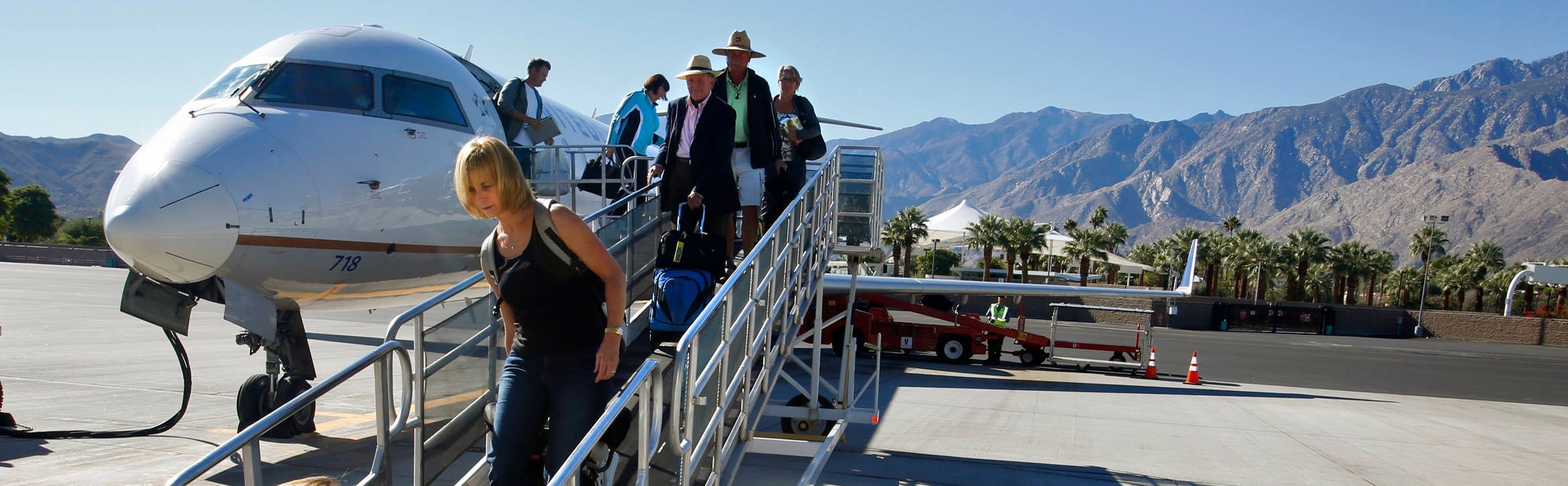
I wrote this piece about the Palm Springs airport during the government shutdown seven years ago, and it feels oddly relevant today: